
How Automatic Brush Making Machines Set Tuft Geometry: Axes, Carriages and Filling Patterns
1. Why Tuft Geometry Is Decided at the Machine
Tuft geometry – the position, angle and spread of each tuft – is fixed the moment the hole is drilled and filled. Trimming can shape the surface afterwards, but it cannot change the angle a tuft leaves the block. That makes geometry a machine-specification question, settled when you choose axes, carriages and tooling.
This is the core difference between automatic machines and manual tufting. On a manual machine the operator sets each position by hand; on a CNC machine the programme does it every cycle, which is what keeps geometry identical from the first brush of a batch to the seven-thousandth. The automation trade-off is compared in manual vs automatic brush making machines.
2. The Five Axes and What Each One Enables
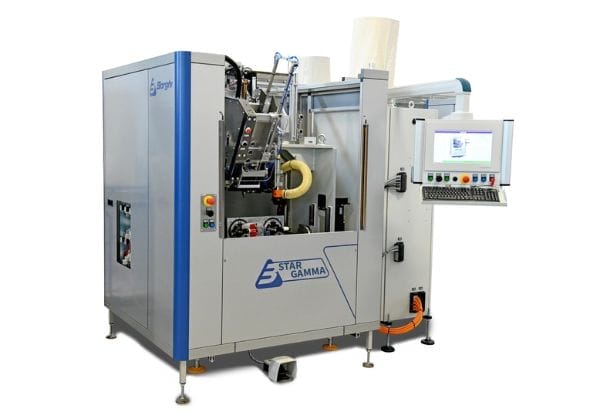
Borghi India’s Star Gamma and Star Delta are 5-axis machines. Each axis is a distinct movement, and the combination is what allows radial, upright and round-head filling on one machine.
| Axis | Movement | What it enables |
| X | Sideways | Positions holes across the width of the block |
| Y | Front and back | Positions holes along the length of the block |
| Z | Up and down | Brings drill and filling tool to the block |
| U | Circular | Circular movement – supports round-head and curved hole patterns |
| V | Radial | Angles holes for radial filling |
Speed follows from configuration: the Star Gamma runs 1 drill and 1 filling tool at 450 tufts per minute, and the Star Delta runs 3 drills and 2 filling tools at up to 1,000 tufts per minute. The drilling and filling side of the cycle is covered on the brush drilling and filling machine page.
3. Upright and Radial Filling on Flat Brushes
Flat brushes are produced in two geometries:
- Upright (parallel) filling: tufts sit perpendicular to the block face. This gives a dense, even working surface – the standard for scrubbing and dish brushes.
- Radial filling: tufts are angled outward across the block, spreading the brush face wider than the block itself. This is the geometry behind brooms and floor brushes.
Both the Star Gamma and Star Delta produce flat brushes with radial or upright filling, and the Star Delta can produce them in a single cycle. Choosing between them is a product decision; switching between them is a tooling and programme change, explained in brush making machine tooling.
4. Round-Head and Semi-Spherical Brushes
Round head toilet brushes need tufts distributed around a curved head rather than across a flat face. The machine handles this with a round-head clamping system combined with circular movement on the U axis, so hole positions follow the curve of the head.
Round-head geometry also changes finishing: a curved profile needs a trimmer that follows it. Borghi India’s dedicated equipment is covered in trimming and finishing machines for round head and semi-spherical brushes. The market case for this product is in how to start a toilet brush making business.
5. Double Hockey Brushes: High-Volume Geometry
The double hockey toilet brush is one of the highest-volume household brushes, and every Borghi brush tufting machine can make it using a double hockey carriage. Hole count and filament height vary by customer, so the programme is set to the specification rather than to a single standard.
At volume, configuration matters. With 6 clamping stations and continuous operation, the Star Delta produces up to 7,000 double hockey brushes in 24 hours. See the double hockey brush machine page and the Star Delta double hockey brush making machine for the full specification.
6. Flare Angle, Mobile Jaws and the Retention Method
Geometry is not only where a tuft sits; it is also how the tuft spreads. The Star Delta offers mobile jaws for a greater flare angle, which changes how the tuft opens and therefore how the finished brush sweeps or scrubs.
Retention method interacts with geometry too. Staple-set suits conventional handle sections at speed; anchor-set, using an anchor bar, allows handle walls as thin as 6 mm, opening up contoured and lighter handle designs. The Star Delta supports both. Full detail is in staple-set vs anchor-set tufting.
7. Carriages and Bridges: Covering 85% of Household Brushes
Three carriage configurations – radial carriage, double hockey carriage, and round-head clamping system – cover roughly 85% of household brushes. Roller and parallel carriages are added for special applications.
| Carriage / bridge | Brushes produced | Geometry |
| Radial carriage | Brooms, floor brushes | Radially angled tufts |
| Double hockey carriage | Double hockey toilet brushes | Customer-set hole count and filament height |
| Round-head clamping | Round head toilet brushes | Tufts around a curved head |
| Roller carriage | Roller and cylindrical brushes | Special application |
| Parallel carriage | Special-application flat brushes | Parallel (upright) tufts |
Through bridge options and interchangeable tooling, the Star Delta can also produce cylinder brushes, cylindrical hairbrushes, tank brushes and discs. Where the line between household and technical production sits is covered in industrial vs household brush making machines.
8. Geometry Carries Through to Finishing
Tuft geometry defines the finishing job. Flat brushes are trimmed to a uniform height, radial brooms are flagged and beaten for a soft, even face, and curved or profiled brushes need a trimmer that follows the shape – the role of the Roto 6 for curved and flat profiles.
Plan the brush trimming and finishing machine stage alongside the automatic tufting machine, so the line is balanced from tufting through to packing. For custom technical work outside the CNC programme, the trade-offs are covered in pre-drilled blocks vs drill-and-fill tufting.
Frequently Asked Questions
What are the five axes on an automatic brush making machine?
X is sideways movement, Y is front-and-back, Z is up-and-down, U is circular movement and V is radial movement. Together they allow radial, upright and round-head filling on one machine.
Can one automatic machine make brooms, toilet brushes and double hockey brushes?
Yes. The Star Gamma and Star Delta produce flat brushes with radial or upright filling, round head toilet brushes and double hockey brushes, by changing carriage and programme.
What does a mobile jaw do?
Mobile jaws, available on the Star Delta, allow a greater flare angle, changing how each tuft spreads on the finished brush.
How many brushes can an automatic machine make per day?
It depends on brush type and configuration. The Star Delta produces up to 7,000 double hockey brushes in 24 hours.