
Building a Profitable Mop Making Business
Mopping the floor is an ancient practice that has been used to clean homes for centuries. Amidst the steady growth of urbanization and the increasing focus on cleanliness and hygiene, the demand for mops is at an all-time high. Mops are vital tools for cleaning in homes, offices, schools, hospitals, and various other places. With different materials, sizes, and colours, they can be customized to match multiple cleaning needs. The shift towards professional housekeeping services and organised retail has kept this demand consistent year after year.
Embarking on a venture to start a mop making business requires an entrepreneur who possesses commitment, creativity, and dedication to producing top-quality mops. The manufacturing process entails selecting optimal raw materials, precision cutting and skilful attachment of necessary components to yield durable and efficient mops. Additionally, the entrepreneur interested in venturing into this business must conduct market research to discern consumers’ needs, competition and market trends.
This blog post endeavours to offer insights into the mop making business using mop manufacturing machines, emphasizing critical steps required to establish, operate, and sustain it. We will explore the factors that influence the business’s success.
1. Market Potential:
The MOP making business holds huge market potential, mainly due to the impact of rapid urbanization. The demand in both urban and rural markets has made it a profitable business venture. MOPs are used for various indoor and outdoor cleaning purposes, and their demand has increased because of heightened awareness of maintaining cleanliness and hygiene. As disposable products are more expensive, people now opt for more sustainable options such as MOPs that can be reused multiple times. Therefore, starting a MOP making business is a wise decision, as it offers a promising opportunity for growth and profit in today’s market.
What Keeps Demand Steady
- Non-seasonal consumption — mops are a consumable, replaced on a fixed cycle rather than bought once.
- Institutional buying — hospitals, hotels and facility management firms purchase in bulk on repeat contracts.
- Organised retail expansion — modern trade shelves require consistent quality and packaging, which machine production delivers.
- Low product complexity — the barrier is equipment, not technology, so an entrepreneur can enter without a technical background.
2. Target Customers:
The target customers for the mop making business are diverse but highly relevant to the venture’s success. Supermarkets, housekeeping agencies, and provision stores represent the key customer segments that will drive the business’s growth and sustainability. These customers need mops for their day-to-day cleaning and maintenance routines. Supermarkets require mops to clean large spaces; provision stores need them for stocking items on high shelves, while housekeeping agencies use them for commercial cleaning. Besides these, hospitals, universities, hotels and large corporate houses all need mops on a daily basis to clean their floors.
By targeting these customers, the mop making business can generate high-volume sales and build a reputation for quality and affordability. Understanding specific customer needs and preferences is essential to tailor products to meet their demands accurately. Customer satisfaction is a critical success factor for the mop making business, and establishing long-term relationships with target customers is necessary to achieve growth and expansion.
Segment Snapshot
| Customer Segment | Buying Pattern | What They Prioritise |
| Housekeeping and facility management agencies | Bulk, repeat, contract-based | Consistent length and weight, price per unit |
| Supermarkets and modern retail | Scheduled purchase orders | Packaging, branding, shelf presentation |
| Hospitals and institutions | Tender or annual contract | Hygiene standards, durability |
| Hotels and corporate offices | Recurring monthly | Finish quality, replacement reliability |
| Provision stores and distributors | Small-lot, high-frequency | Margin, availability, credit terms |
3. Raw materials required:
A mop making business is an opportunity for entrepreneurs looking to start their venture with low investment. The required raw materials include mop yarn, mop pipe, mop clip, and packaging covers, and they are readily available from large scale producers. Starting a successful mop making business requires a minimum of 1,000 sq. ft. area with a reliable electricity supply. This space should be well-ventilated and free from moisture to maintain the product’s quality.
The production process involves assembling the mop yarn onto the mop clip attached to the mop pipe, which is then packaged in covers. With a well-organized setup and skilled labour, the production process’s efficiency can increase to meet the market’s demand for the product.
Input Checklist
- Packaging covers and cartons — for retail-ready dispatch
- Mop yarn — cotton or synthetic, supplied on spools
- Mop sockets — plastic or metal, fed to the machine by the operator
- Staples — used to secure the yarn to the socket during the assembly cycle
- Mop pipe or handle — sourced separately, assembled at the packing stage
4. Machinery Infrastructure:
The mop making process requires the use of state-of-the-art machinery, with the high output mop making machine being the most crucial. This machine comes equipped with advanced technology, producing high-quality mop heads that ensure efficiency and cost-effectiveness. Using measurement scales will help to ensure accurate proportions of materials used for each mop, saving labour and time, thus streamlining the production process. Investing in such machinery increases productivity and ensures quality, resulting in high-quality products.
How the Machine Works
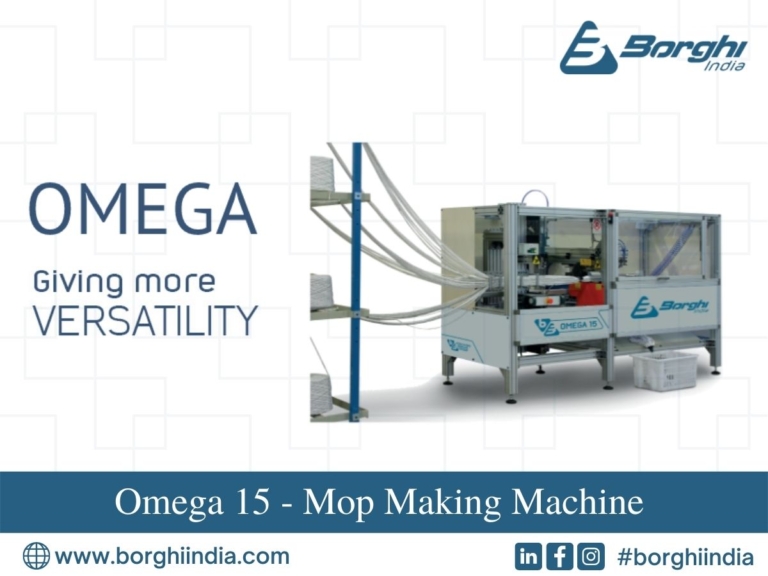
The Omega 15 mop making machine is a semi-automatic machine for the assembly of mops made from both cotton and synthetic material. An operator feeds the machine with plastic or metal sockets and staples and enables the assembly cycle. The mop is then pulled towards the unloading area, where the machine automatically cuts it to the desired length and ejects it. This removes the two slowest manual steps — measuring and cutting — from the process entirely.
Omega 15 Technical Data
| Specification | Value |
| Minimum mop length | 340 mm |
| Maximum mop length | 1200 mm |
| Maximum socket width | 200 mm (8 inches) |
| Output at 500 mm mop length | 300 mops/hour |
| Power consumption | 0.5 kW |
| Air consumption | 12.3 cfm @ 5 bar |
| Weight | 750 kg |
| Dimensions | L 3200 × W 1500 × H 1900 mm |
Available Options
- Spool rack — holds up to 60 cotton spools to keep the machine fed without interruption
- BTP 800 slitting unit — cuts non-woven material spools and feeds the machine with non-woven strips
- Conveyor belt — unloads finished product automatically
- Packaging unit — standalone packing station available
Indicative Production Capacity
Working from the verified rate of 300 mops per hour at 500 mm mop length:
| Working Pattern | Approximate Output |
| One 8-hour shift | 2,400 mops |
| Two 8-hour shifts | 4,800 mops |
| One shift × 26 working days | 62,400 mops per month |
These figures are calculated from the machine’s rated hourly output at continuous running. Real output will be lower once changeovers, loading and maintenance are accounted for. Discuss your specific mop length and socket size with our team for a realistic capacity plan.
For a wider view of equipment options across cleaning-product manufacturing, see the full machines range and the guide on buying a mop making machine.
5. Manpower Requirements:
To run a successful mop making business, having the right personnel in place is vital. It is recommended to have one skilled worker and two unskilled workers for efficient machinery operations. The skilled worker will operate and maintain the machinery, while the unskilled workers will assist with tasks such as sorting finished products and packaging for shipment. Proper worker training is essential to ensure their effective performance, and a supervisor should be designated to oversee the production process and ensure quality standards are met. By hiring the right team, the mop making business can operate effectively, deliver quality products, and satisfy customers.
6. Business Model and Growth:
To ensure stable revenue streams while mitigating risks and expenses, choosing the right business model is critical. Targeting local suppliers and wholesale markets can increase revenue streams. Collaboration with office and house cleaning companies to offer quality mops at competitive prices can also create business opportunities. Selling products on e-commerce platforms like Amazon and Flipkart can help in expanding customer bases, increasing sales volume and revenue. With a well-planned business model and growth strategy, a mop making business can thrive and succeed in a competitive marketplace.
Three Routes to Market
- Contract supply — supply housekeeping agencies and institutions on annual or half-yearly contracts. Lowest marketing cost, most predictable volume.
- Distributor network — sell through regional distributors into provision stores and hardware retail. Lower margin per unit, faster volume ramp.
- Own brand retail — package and list on e-commerce platforms and in modern trade. Highest margin, requires investment in branding and packaging.
Most operations start with route 1 or 2 to load the machine, then build route 3 once production is consistent.
7. Expanding the Business:
The mop making industry has vast market potential, making it possible to expand the business by introducing other cleaning solutions. Including wipers and dry mops can be a smart move by providing efficient and effortless floor-cleaning options. Investing in modern technologies and equipment to produce quality products can improve the business’s reputation, and attract and retain customers. The expansion of the business can result in increased revenues and improved market share in the cleaning industry.
Natural Adjacencies
The same customer — a housekeeping agency or a supermarket buyer — buys more than mops. Once you are supplying them, adding a second product line is far cheaper than acquiring a new customer.
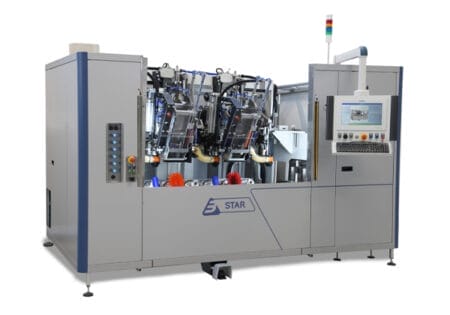
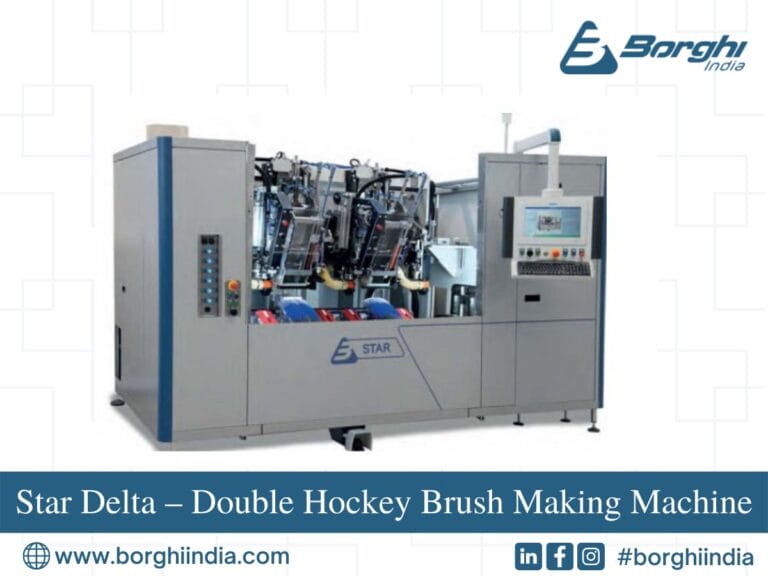
- Household brushes and brooms — produced on household brush machines such as the Star Gamma and Star Delta
- Toilet brushes — a high-repeat consumable; see how to start a toilet brush making business
- Technical and twisted brushes — bottle brushes, tube brushes and industrial cleaning brushes
If you are planning a multi-product facility from the outset, the guide to building a complete brush production line explains how drilling, filling and trimming stages fit together.
8. Profit Margin
The mop making business is an attractive investment opportunity for entrepreneurs who seek a profitable venture with vast market potential. Efficient utilization of resources and cost-effective production techniques can yield healthy profit margins and a strong return on every rupee invested. Such margins are achievable by maintaining competitive pricing for customers while implementing sound financial management practices and a well-structured business strategy. Nonetheless, it is crucial to recognize that sustaining high margins requires ongoing planning, monitoring, and evaluation of key performance indicators (KPIs).
What Actually Drives Margin
- Machine utilisation — an underloaded machine carries the same fixed cost as a fully loaded one. Utilisation is the single largest margin lever.
- Yarn cost and yield — waste at the cutting stage directly reduces margin. Automatic cutting at a set length keeps yield consistent.
- Labour per unit — fixed at three workers regardless of output, so cost per mop falls as volume rises.
- Channel mix — own-brand retail carries higher margin than distributor supply, but slower payment cycles.
- Power cost — at 0.5 kW consumption, the Omega 15’s energy cost per unit is marginal.
Margins vary significantly by raw material cost, channel and region. Model your own numbers against current local yarn and socket pricing before committing capital.
9. Promoting Your Business
Advertising and networking with potential clients are essential strategies for growing the mop making business. Promoting the business through advertisements can increase its visibility, reach a broader audience, and drive sales. Numerous advertising channels, including online advertisements, Instagram and Facebook ads, can be used based on the budget, target market, and specific goals. Networking with potential clients, joining local business organizations, and attending industry events is a way to establish valuable relationships with professionals, expand your client base, and learn more about the competition. Participating in exhibitions relating to the clean and hygiene industry can always bring positive results.
Where B2B Buyers Actually Find Suppliers
- Direct outreach — a sample and a price list sent to local housekeeping agencies converts faster than any ad
- B2B marketplaces — IndiaMART, TradeIndia and similar platforms remain the first search stop for institutional buyers
- Trade exhibitions — cleaning and hygiene expos put you directly in front of facility management decision-makers
- Google Business Profile — essential for regional buyers searching for a nearby manufacturer
10. Continuously Monitoring & Evaluating
Continuously monitoring and evaluating business metrics such as sales revenue, expenses, profit margins, customer retention rates, and production efficiency can drive informed decisions for growth and profitability. By tracking these KPIs, areas of strength and opportunities for improvement can be identified and utilized to forge a strategic approach to product offerings, production techniques, pricing strategies, and marketing efforts. Regularly monitoring and evaluating business metrics should be integrated into the business’s ongoing process to ensure continued growth and profitability.
KPIs Worth Tracking Weekly
- Repeat order rate by customer
- Mops produced per shift against rated capacity
- Machine downtime hours and cause
- Yarn consumed per 100 mops (yield control)
- Rejection or rework rate at final inspection
- Order-to-dispatch turnaround time
Frequently Asked Questions
How much space is needed to start a mop making business?
A minimum of 1,000 sq. ft. with a reliable electricity supply. The space should be well-ventilated and free from moisture to protect product quality. The Omega 15 machine itself occupies a footprint of 3200 × 1500 mm.
How many mops can a mop making machine produce per hour?
The Omega 15 produces 300 mops per hour at a 500 mm mop length. Output varies with mop length and socket size.
What raw materials are needed for mop manufacturing?
Mop yarn (cotton or synthetic), mop sockets in plastic or metal, staples, mop pipes or handles, and packaging covers. All are available from large-scale producers.
How many workers are needed to run a mop making unit?
One skilled machine operator and two unskilled assistants, plus a supervisor to oversee quality and production. The machine’s automatic cutting and unloading keep the labour requirement flat as volume increases.
Can one machine produce both cotton and synthetic mops?
Yes. The Omega 15 runs spool racks of both cotton yarn and synthetic material, so a single machine can serve both product lines without a changeover in equipment.
What mop lengths can be produced?
Between 340 mm and 1200 mm, with a maximum socket width of 200 mm (8 inches). The machine cuts to the set length automatically and ejects the finished mop.
Is mop making a low-investment business?
It is among the lower-capital manufacturing options in the cleaning products category — raw materials are readily available, the space requirement is modest, and a three-person team can run the operation. Equipment is the main capital item.
Start Your Mop Manufacturing Unit
To summarize, the mop making business is lucrative and has steady domestic and international demand. By adopting modern production methods and using sustainable raw materials, entrepreneurs can build a successful business venture catering to the hygiene needs of millions of households. By implementing proper planning, marketing, and financial management practices in the business operations, entrepreneurs can tap into the growing market and establish a profitable business while providing effective cleaning solutions. The mop making business, with its low investment and high returns potential, can offer a platform for aspiring entrepreneurs to carve out their success story.
Borghi India supplies Italian-engineered mop making machinery across India, Nepal and Bangladesh, with spare parts and technical assistance available locally. To discuss machine selection, capacity planning or a factory visit, contact our team or read the top 10 reasons to buy the Omega 15 mop making machine.