
Staple-Set vs Anchor-Set Tufting
Staple-Set vs Anchor-Set Tufting: How to Choose the Right Filling Method
Short answer: staple-set tufting secures a bristle bundle with a thin metal staple driven into the drilled hole. Anchor-set tufting uses a loop of wire anchored at the bottom of the hole. Staple-set is the standard high-speed method for conventional handles; anchor-set is what lets you tuft thin-wall handles -down to 6 mm -and is the route to lighter, more design-led handle shapes.
1. Where tufting sits in the brush production line
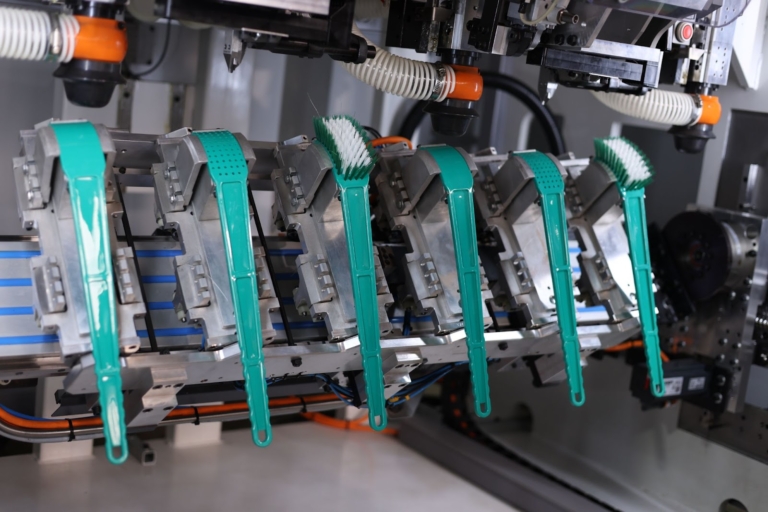
Every drilled-and-filled brush is made in one continuous machine cycle: the drill makes a hole in the brush block or handle, and the filling tool inserts a bundle of filaments into that hole and mechanically locks it in place. That lock is the retention method -and it is either staple-set or anchor-set. Everything downstream, from trimming to flagging to packing, assumes the tuft will stay put.
Because retention is decided at the filling tool, it is a machine specification question, not a finishing question. Choose the wrong capability at purchase and you cannot add the product type later without retooling. The machine-level view is in the brush drilling and filling machine overview.
2. How staple-set tufting works
In staple-set tufting, the filling tool folds a bundle of filaments around a small metal staple and drives the staple into the drilled hole. The staple bites into the hole wall and holds the folded tuft in place. Filaments end up doubled over, so a 40 mm tuft comes from roughly 80 mm of filament, and the retention strength comes from the mechanical grip of the staple against the material of the block.
It is the fastest and most widely used method in household brush production. It suits handles with enough wall thickness to take a staple without splitting, and it runs well at continuous high speed -which is why it is standard across household brush machines.
3. How anchor-set tufting works
Anchor-set tufting replaces the staple with a loop of wire anchored at the bottom of the hole. The tuft is retained by that anchor rather than by a staple gripping the hole wall, which changes what the handle has to withstand. The practical consequence is significant: using an anchor bar, brushes can be manufactured on handles with walls as thin as 6 mm.
That opens up handle designs -hollow, contoured, material-light -that staple-set simply cannot support. For manufacturers who want handle shapes that are theirs rather than copies of what is already on the market, anchor-set is often the enabling technology. Borghi India does not supply moulds, but does help customers design distinctive handles and provides references to mould manufacturers.
4. Staple-set vs anchor-set: side by side
| Consideration | Staple-set | Anchor-set |
| Retention mechanism | Metal staple driven into the drilled hole | Wire loop anchored at the bottom of the hole |
| Minimum handle wall thickness | Needs conventional wall thickness | Down to 6 mm using an anchor bar |
| Typical use | Volume household brushes, brooms, dish brushes | Thin-wall, hollow and design-led handles |
| Consumable | Staples | Anchor wire |
| Handle design freedom | Constrained by wall thickness | Wider -lighter and contoured handles possible |
| Availability on Borghi machines | Standard | Standard, with mobile jaws available for a greater flare angle |
The last row matters more than it looks. Mobile jaws let the filling tool set the tuft at a wider flare angle -that is what gives a brush a fanned, broader sweep face instead of a straight vertical tuft, and it is a visible product difference on brooms and dish brushes. Borghi’s Star Delta supports both retention methods with mobile jaws for exactly this reason.
5. Which brushes call for which method
| Brush type | Common route | Why |
| Double hockey toilet brush | Either -both are used | Hole count and filament height vary by customer; both methods are supported on a Borghi tufting machine |
| Round-head toilet brush | Typically staple-set | Round head clamping system, conventional handle sections |
| Dish and kitchen brush | Staple-set | High volume, conventional handle thickness |
| Broom and lag brush | Staple-set | Thick blocks, speed matters more than handle design |
| Thin-wall or hollow handle brush | Anchor-set | Wall thickness below what a staple can hold |
| Cylinder and tank brushes | Depends on the block | Selected with the bridge and clamping configuration |
Double hockey is worth calling out because it is the highest-volume Indian brush format and is genuinely flexible: hole count, hole diameter and filament height all vary by end customer, and both retention methods can produce it. The machine configuration for it is covered on the double hockey brush machine page. If toilet brushes are your entry product, the commercial groundwork is in how to start a toilet brush making business.
6. What your machine and tooling must support
Retention method is one line in a specification that also has to cover axes, tooling range and output. On Borghi India’s vertical tufting machines:
• Five axes of movement -X sideways, Y front and back, Z up and down, U circular, V radial -driven by brushless servomotors. This is what allows radial, upright and round-head filling on one machine.
• Filling tool range 2.2 mm to 7.5 mm hole diameter, with fibre lengths from 40 mm to 300 mm.
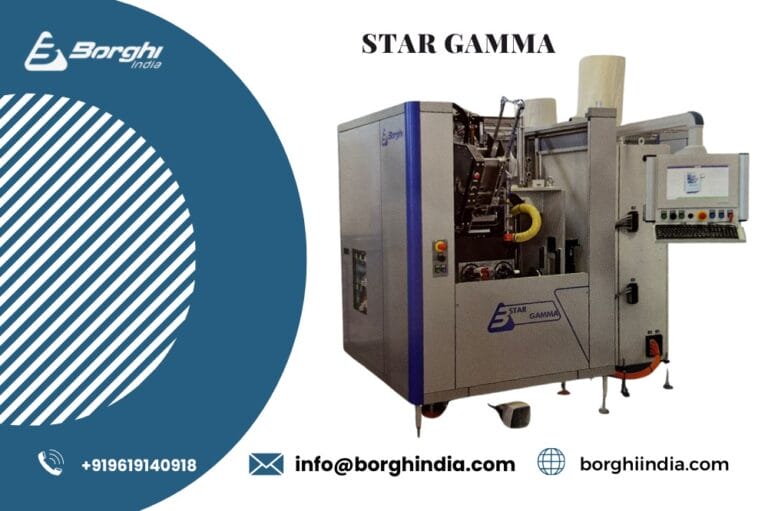
• Output is measured in tufts per minute, with models available from 240 up to 1,200 tufts per minute. The Star Gamma runs 1 drill and 1 filling tool at 450 tufts/minute; the Star Delta runs 3 drills and 2 filling tools across 6 clamping stations at up to 1,000 tufts/minute, producing over 7,000 double hockey brushes in 24 hours.
• Bridge and carriage options -radial carriage, double hockey carriage, round-head clamping -cover roughly 85% of household brush types on three carriage configurations.
If you are still deciding between automation levels rather than retention methods, start with manual vs automatic brush making machines, then look at the capability set on the automatic brush making machine page.
7. Consumables, changeover and cost per brush
Both methods consume metal -staples in one case, anchor wire in the other -so the input cost difference is usually smaller than buyers expect. What actually moves cost per brush is changeover time and scrap rate. A machine that switches between retention methods and brush models quickly loses less production to setup, and Borghi machines are specified for fast changeover between setups precisely because a single-machine plant has to serve several product types.
Filament choice interacts with this too -heavier or coarser filament needs a larger filling tool and can behave differently under a staple than under an anchor. The material side is covered in the guide to brush filament types.
Frequently asked questions
What is staple-set tufting? Staple-set tufting uses a thin metal staple to secure a bundle of bristles inside the drilled hole, with the staple gripping the hole wall to retain the folded tuft.
What is anchor-set tufting? Anchor-set tufting uses a loop of wire anchored at the bottom of the drilled hole to hold the bristles in place, rather than a staple driven into the hole wall.
Which method works on thin-wall handles? Anchor-set. Using an anchor bar, brushes can be produced on handles with walls as thin as 6 mm.
Can one machine do both? Yes. Borghi’s Star Delta supports staple-set and anchor-set tufting, including mobile jaws for a greater flare angle.
Does the retention method change the machine’s output? Not directly -output is governed by the number of drills and filling tools and is measured in tufts per minute, from 240 up to 1,200 depending on model.
Which method should a new manufacturer start with? Start from the product. If your first products are conventional double hockey or dish brushes, staple-set covers you. If your handle design depends on thin walls, you need anchor-set capability from day one.