
How to Succeed in Brush Making Business: The Ultimate Guide
Have you ever wanted to start your own brush making business? It can be a lucrative endeavour, but it is not without its challenges. In this guide, we will walk you through what you need to know to start and run a successful brush making business — choosing the right materials, selecting machinery, and building a customer base that comes back. Whether you are just starting out or have been in brush making for a while and want to take things further, this guide is for you.
1. Collect good Ideas:

The most important thing for any business is to have good ideas. You need to be constantly thinking about ways to improve your products, reach new markets, and stand out from the competition. A great way to generate new ideas is to talk to other brush makers and see what they are doing.
When you find a good brush, take a picture and examine it. Reflect on what makes it useful and how you could make it better. Doing this consistently is how you end up manufacturing a superior product rather than a copy of what is already on the shelf.
Where the Product Ideas Actually Are
Ideas in this industry come from three places, in order of usefulness:
- Customer complaints about existing products — a housekeeping supervisor who says the bristles fall out after six weeks has just told you your specification
- Formats the market is under-served on — walk a hardware market and note which brush types are only available imported, or only in one size
- Adjacent categories your machine already covers — if you are tufting toilet brushes, the same machine may produce dish brushes and cobweb brushes with a tooling change
Know What Is Producible Before You Design
A brush idea is only worth pursuing if it can be made on equipment you can afford. The household and technical brush range covers:
- Flat brushes with radial filling
- Flat brushes with upright filling
- Round head toilet brushes
- Indian double hockey brushes
- Swedish-type dish washing brushes
- Cylinder brushes and cylindrical hairbrushes
- Disc brushes
- Carpet, cobweb and shoe brushes
- Twisted brushes — bottle brushes, tube brushes and similar
Filling-tool hole diameters span 2 mm to 7.5 mm, which sets the practical limits on tuft size. Before you commit to a design, check it against that range. See the household brush machines and technical brush machine ranges for what each machine family produces.
2. Have Good Plans:

After you have collected some good ideas, it is time to start planning your brush manufacturing business. You need to decide what type of brushes you want to make, what materials you will use, how you will market your business, and more. This can be daunting, but a clear plan before you start is what separates a business from an expensive hobby.
When making your plans, be sure to consider the following:
- What type of brushes do you want to make?
- What materials will you use?
- How will you market your brushes?
- Where will you sell your brushes?
- How will you manufacture your brushes?
- What are your financial goals?
By taking the time to develop a detailed plan, you increase your chances of success and avoid costly mistakes.
Materials: Know Your Filament Options
Filament choice drives both your product positioning and your largest recurring cost. The machines handle:
| Category | Materials |
| Synthetic filaments | PP, PET, Nylon, abrasive filaments |
| Natural fibres | Palmyra, Cocoa, Tampico |
| Metallic | Wire, for twisted and industrial brushes |
Sourcing is where new entrants lose the most money — either overpaying, or buying inconsistent stock that produces rejects. Borghi India discloses its verified network of filament and wire manufacturers on machine order, which removes the trial-and-error phase most new manufacturers pay for in scrap.
Space, Power and Working Capital
Plan the physical setup properly before you sign a lease:
- Space: 1,000 to 2,000 sq. ft. for tufting machines, plus additional area for raw material storage and finished goods
- Layout: separate zones for raw material storage, production (drilling and tufting), finishing (trimming and flagging), and finished goods
- Location: an industrial area near a major city, close to both raw material suppliers and your target market
- Working capital: three to six months of operating expenses covering labour, utilities and raw material replenishment
That last point is the one most plans get wrong. A machine you can afford but cannot feed with raw material for two quarters is not an asset.
Plan the Growth, Not Just the Launch
Plan to increase your production each year and take every opportunity to add adjacent products. Build a brand you can be proud of — one that attracts customers equally committed to its success. A strong brand lets you focus marketing on sales incentives rather than constant customer acquisition, which is where sustained growth comes from.
The practical version of that: get one product right, land repeat institutional customers on it, then add the second SKU using the same machine and the same customers. Route to market matters as much as product — building a brush production line explains how capacity scales stage by stage..
3. Give Yourself Time:

One of the most important things to remember when starting a brush making business is to give yourself time. This is not a business that produces results overnight. It takes time to build a customer base, refine your production, and get your name known. Do not be discouraged if results are slow at first.
Time is also crucial when building a brand. A strong, recognisable brand requires patience and consistency in marketing. It takes time to build trust and credibility with buyers, particularly institutional ones who are slow to switch suppliers and then slow to leave.
A Realistic First-Year Sequence
Rather than a vague instruction to be patient, here is roughly how the first year sequences:
| Phase | Focus |
| Setup | Machine installation and commissioning, operator training, first-article samples |
| Early production | One or two SKUs, tight quality control, yield and scrap measurement |
| First customers | Local distributors and housekeeping agencies — fastest to close, lowest marketing cost |
| Consistency | Repeatable output, reliable dispatch, spares and maintenance routine established |
| Expansion | Second product line on existing tooling, or a second machine if the first is saturated |
The mistake is compressing this. Launching five SKUs in month two, before your yield is stable, produces five inconsistent products and no reference customers.
What to Measure While You Wait
Patience without measurement is just waiting. Track from day one:
- Output per shift against rated machine capacity
- Machine downtime hours and cause
- Filament consumed per 100 brushes — your yield control number
- Rejection and rework rate at final inspection
- Repeat order rate by customer
Repeat order rate is the single most predictive number in this business. A customer who reorders is worth more than three who trial.
4. Change Yourself:

If you are not happy with your current plan, it is time for a change — and you have to be the one to make it. Your customers build your brand, not the other way around. Change begins with you and your team: set emotion aside and look at the business pragmatically, as a set of problems that can be solved.
Building a successful brush making business takes hard work and dedication. It will be difficult at times, and it is worth remembering that you are the one who wants it to succeed.
The Change That Matters Most: Quality Positioning
Ultimately the most important shift is from producing a low-quality brush to a high-quality one. That is not a slogan — it is a set of specific operational decisions:
- Consistent tuft retention — staple-set or anchor-set filling that mechanically locks bristles into the block, rather than adhesive or loose fitting
- Uniform bristle length — trimming and finishing as a dedicated stage, not an afterthought
- Repeatable dimensions — servo-controlled machines hold specification across a run where manual methods drift
- Filament consistency — verified suppliers rather than whoever is cheapest that month
Buyers who pay more do so because the product is measurably better, not because it is described as better. Every item above is verifiable by the customer.
Stay Adaptable
The brush making industry changes — formats, materials and buyer expectations all move. What works now may not work in five years. Being willing to add a product, change a material, or upgrade a machine when the numbers justify it is what keeps a business ahead rather than defending a position that has already moved.
A practical example: manufacturers who started with household brushes and later added trimming and finishing machines were able to serve buyers who reject untrimmed product — a market they simply could not access before.
Matching Machines to Your Production Stage
Most business plans in this industry fail on machine selection — either buying above realistic volume and tying up capital in idle capacity, or buying below it and capping growth within a year.
Tufting and Filling Machines
| Specification | Theta Manual | Star Gamma | Star Delta |
| Drills | — | 1 | 3 |
| Filling tools | 1 | 1 | 2 |
| Axes | — | 5 | 5 |
| Speed | 50 tufts/min | 450 tufts/min | 1,000 tufts/min |
| Power consumption | 0.2 kW | 2.6 kW | 5 kW |
| Weight | 150 kg | 1,300 kg | 3,200 kg |
| Best suited to | Pre-drilled blocks, lowest entry cost | Small runs, frequent model changes | Continuous high-volume production |
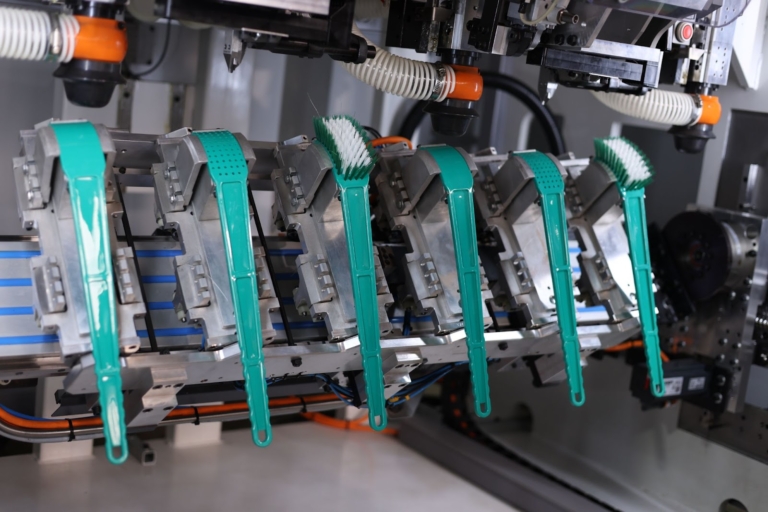
The Star Delta runs 6 clamping stations with continuous operation and produces up to 7,000 double hockey brushes in 24 hours. It supports both staple-set and anchor-set tufting, including mobile jaws for a greater flare angle.
Trimming and Finishing Machines
| Machine | Production | Best suited to |
| Roto 6 | 1,200 brushes/hr | Flat and curved profiles, 6 clamps across 4 workstations |
| Roto B | 520 brushes/hr | Round brushes — toilet brushes, cobweb dusters, glass-washing brushes |
| Roto Tip | 120–150 pieces/hr | Tipping with rotary blades and heater |
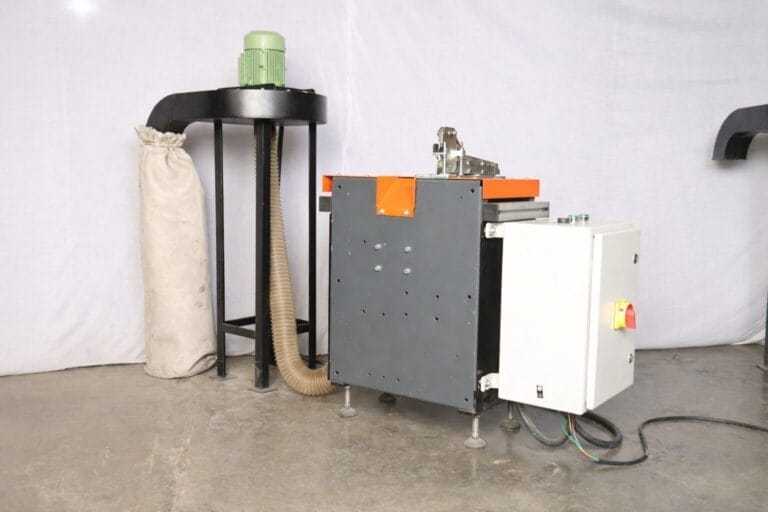
| Roto Trim | Operator dependent | Manual trimming, lowest entry cost at 26 kg |
Browse the full machines catalogue or the accessories range for tooling and consumables.
Frequently Asked Questions
How much space is needed for a brush manufacturing business?
1,000 to 2,000 sq. ft. for tufting machines, plus additional area for raw material storage and finished goods. Plan separate zones for storage, drilling and tufting, trimming and flagging, and finished goods.
What raw materials are used in brush manufacturing?
Synthetic filaments (PP, PET, Nylon and abrasive filaments), natural fibres (Palmyra, Cocoa and Tampico), and metallic wire for twisted and industrial brushes. Also brush blocks or handles, staples and packaging.
Which brush making machine should a beginner buy?
It depends on volume and product range. The Theta Manual suits pre-drilled block work at the lowest entry cost. The Star Gamma suits small runs with frequent model changes. The Star Delta suits continuous high-volume production.
How much working capital does a brush making business need?
Plan for three to six months of operating expenses covering labour, utilities and raw material replenishment, in addition to machinery and setup costs.
What types of brushes can be manufactured on one machine?
A vertical tufting machine can produce flat brushes with radial or upright filling, round head toilet brushes, double hockey brushes, dish brushes, cylinder brushes and disc brushes — with tooling changes rather than a second machine.
How long before a brush making business becomes profitable?
There is no universal figure — it depends on your capital structure, product mix and route to market. What is consistent is the sequence: stable production quality first, then reference customers, then expansion. Compressing that sequence is the most common reason new units struggle.
What is the difference between staple-set and anchor-set tufting?
Staple-set uses a thin metal staple to secure bristle bundles in the drilled hole. Anchor-set uses a loop of wire anchored at the bottom of the hole. Both lock bristles mechanically; the right choice depends on brush type and bristle material.
Does Borghi India help with raw material sourcing?
Yes. Borghi India discloses its verified network of filament and wire manufacturers on machine order, as part of a turnkey package covering tools, raw materials, spare parts and technical assistance.
Putting It Into Practice
By following these four steps — collecting good ideas, planning properly, allowing realistic time, and being willing to change — you improve your chances in the brush making industry considerably. None of them is complicated. All of them are regularly skipped.
The most useful next step is not more reading. It is putting numbers against your plan: which brush types, what monthly volume, what filament, what budget. Borghi India supplies Italian-engineered brush making machinery across India, Nepal and Bangladesh, with training, raw material sourcing references, spare parts and technical support included.